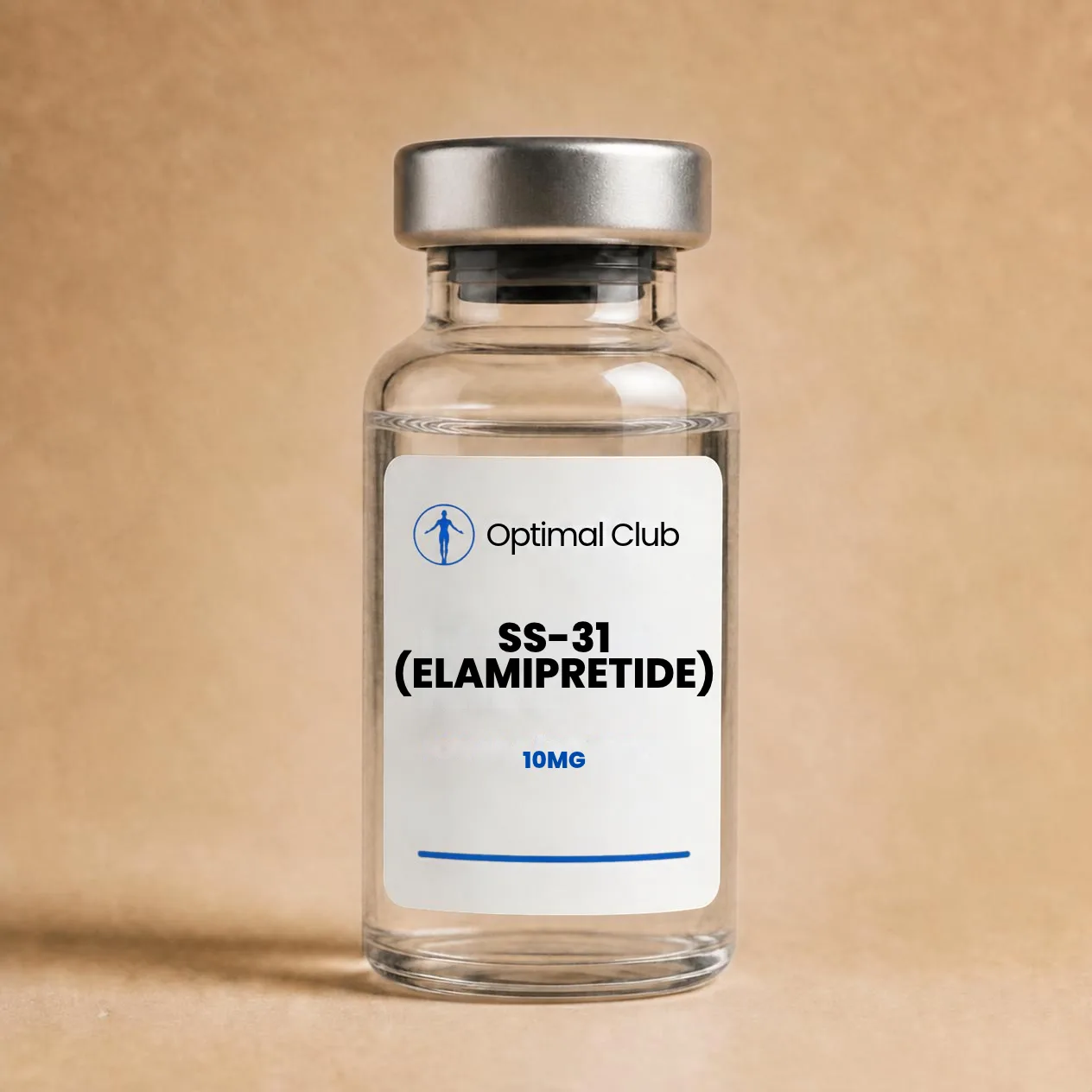
SS-31 is also known as elamipretide. It is a mitochondria-targeted tetrapeptide studied for its effects on mitochondrial structure and function. Elamipretide interacts with cardiolipin, a phospholipid found in the inner mitochondrial membrane, and has been investigated in mitochondrial disorders and other conditions involving mitochondrial dysfunction.
In the United States, the FDA approved Forzinity (elamipretide) in September 2025 under the accelerated approval pathway for improving muscle strength in adults and children with Barth syndrome who weigh at least 30 kg.
The important point is that this approval does not mean that every SS-31 or elamipretide formulation has the same FDA-approved status or indications.
What Is SS-31 (Elamipretide)?
SS-31 is a synthetic aromatic-cationic tetrapeptide also known as elamipretide or MTP-131. Research has focused on its ability to reach the inner mitochondrial membrane and interact with cardiolipin.
Cardiolipin plays an important structural and functional role within mitochondria. Because of this interaction, researchers have investigated elamipretide as a mitochondria-targeted therapeutic approach.
How Does Elamipretide Work?
Elamipretide is designed to localize to the inner mitochondrial membrane, where it interacts with cardiolipin.
Preclinical research suggests that this interaction can influence mitochondrial membrane structure and oxidative phosphorylation. However, findings from laboratory and animal studies do not establish clinical benefits in healthy individuals.
The FDA describes elamipretide as a mitochondrial cardiolipin binder in the approved Forzinity labeling.
What Does the Clinical Research Show?
Researchers have studied elamipretide in several human clinical trials, particularly in mitochondrial diseases.
In the MMPOWER-2 randomized crossover trial, 30 adults with genetically confirmed primary mitochondrial myopathy received subcutaneous elamipretide or placebo. The primary 6-minute walk test endpoint did not reach statistical significance, although several patient-reported fatigue and muscle-symptom measures favored elamipretide.
However, the larger MMPOWER-3 phase 3 trial produced a different result. Among 218 participants with primary mitochondrial myopathy, elamipretide did not significantly improve the 6-minute walk test or total fatigue score after 24 weeks compared with placebo.
These results are important because they show why research findings should not be presented as established benefits for people without the studied conditions.
Elamipretide and Barth Syndrome
Barth syndrome is a rare genetic disorder involving mitochondrial function and cardiolipin metabolism.
In September 2025, the FDA granted accelerated approval to Forzinity for improving muscle strength in adults and pediatric patients with Barth syndrome who weigh at least 30 kg. The approval was based on improvement in knee extensor muscle strength, which the FDA considers an intermediate endpoint reasonably likely to predict clinical benefit. A confirmatory trial is required as a condition of continued approval.
This approval is important for understanding the current regulatory status of elamipretide, but it does not establish elamipretide as an FDA-approved treatment for general mitochondrial health, healthy aging, exercise performance, or longevity.
Is SS-31 FDA Approved?
Elamipretide, an FDA-approved active ingredient for the specific drug product Forzinity, has received FDA approval for a specific indication.
Forzinity is indicated for the treatment of adult and pediatric patients with Barth syndrome weighing at least 30 kg, with the FDA approval granted through an accelerated approval pathway.
It is vital that a distinction be made between FDA-approved drug products and compounded preparations.
A compounded SS-31/elamipretide preparation should not be considered FDA-approved merely because the FDA has approved elamipretide for use in the prescription drug Forzinity.
Safety and Side Effects
Clinical data show that injection-site reactions are an important safety consideration with elamipretide.
In the FDA-reviewed Barth syndrome trial, local administration reactions occurred in all 12 patients receiving Forzinity. Reported reactions included injection-site redness, pain, induration, itching, bruising, and urticaria.
The FDA prescribing information also warns about hypersensitivity reactions, including serious allergic reactions requiring emergency treatment. The approved product contains benzyl alcohol and has specific warnings regarding neonatal exposure.
These safety findings come from clinical development of elamipretide and the FDA-approved Forzinity product. They should not be interpreted as establishing the safety profile of every compounded SS-31 formulation.
SS-31 and Mitochondrial Research
Mitochondria are responsible for many essential cellular processes, including oxidative phosphorylation and ATP production.
Because elamipretide targets the mitochondrial inner membrane, researchers have investigated whether it can influence mitochondrial bioenergetics. A randomized study involving healthy older adults reported changes in skeletal-muscle mitochondrial energetic capacity after a single dose, but these findings do not establish a clinical benefit for healthy aging or general energy levels.
SS-31 Clinical Evaluation
A licensed healthcare provider should evaluate whether treatment is appropriate for an individual patient.
Clinical decisions should consider medical history, current medications, underlying conditions, potential risks, and the specific formulation being considered.
For compounded formulations, the provider should also consider the regulatory status and whether compounding is appropriate under applicable federal and state requirements.