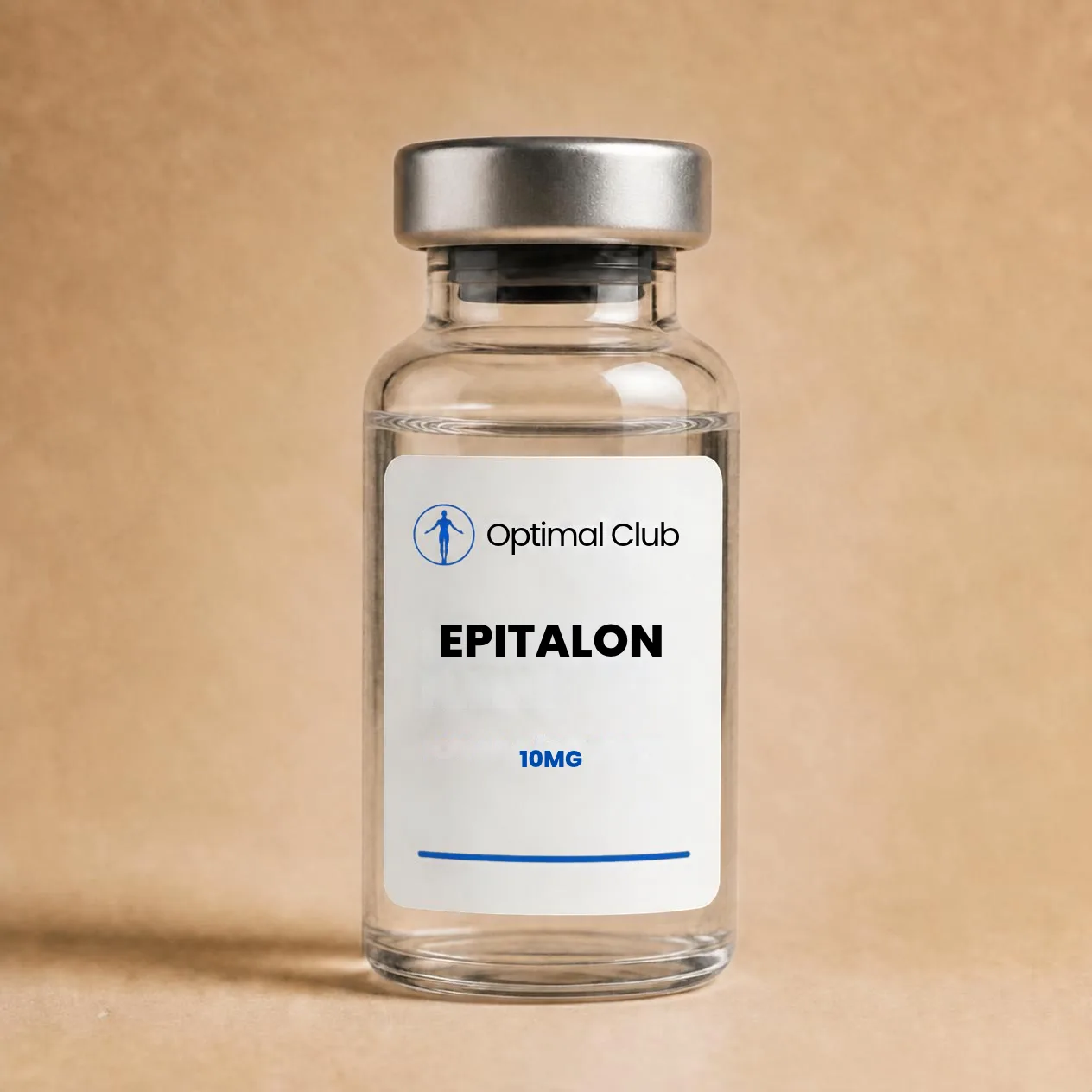
Epitalon 10 mg is a formulation containing Epitalon, a synthetic tetrapeptide composed of four amino acids: alanine, glutamic acid, aspartic acid, and glycine (Ala-Glu-Asp-Gly). Research has examined Epitalon in laboratory, animal, and limited human studies involving areas such as cellular aging, circadian biology, and retinal disorders. However, clinical evidence remains limited, and Epitalon is not FDA-approved for any medical use in the United States.
Note: The 10 mg designation is not a recommended patient dose. It only refers to the formulation strength.
What Is Epitalon?
Epitalon, also spelled Epithalon, is a synthetic tetrapeptide with the amino-acid sequence Ala-Glu-Asp-Gly (AEDG).
It was developed from research involving pineal peptides and has been investigated for biological effects related to aging, cellular signaling, circadian biology, and retinal function. Much of the research comes from preclinical studies, with a smaller body of human research.
An important distinction is that Epitalon is not the same substance as Epithalamin. Epithalamin refers to a pineal-gland peptide preparation or extract, while Epitalon is a defined synthetic tetrapeptide. Human studies involving Epithalamin should not automatically be presented as clinical evidence for Epitalon.
How Does Epitalon Work?
The biological mechanisms of Epitalon have not been fully established.
Laboratory research has investigated its effects on gene expression, telomerase activity, telomere biology, and other cellular processes. A 2003 laboratory study reported increased telomerase activity and telomere elongation in cultured human fetal fibroblasts exposed to Epithalon. These findings describe a cellular experiment and do not establish that Epitalon increases telomere length in living people or improves health outcomes. More recent laboratory research has also investigated Epitalon's effects on telomere length and telomerase-related pathways in different cell types. These findings provide areas for further research but do not demonstrate that Epitalon lengthens telomeres or slows aging in humans.
What Does the Research Say?
The evidence for Epitalon consists mainly of cell and animal studies, along with a limited number of older human reports.
Cellular and Animal Research
A 2003 study in female mice examined Epitalon in relation to biomarkers of aging, lifespan, and spontaneous tumor development. The researchers reported effects on some aging-related measures and lifespan in the experimental animals. These findings are preclinical and cannot be used to establish effects on human lifespan or longevity.
Research in non-human primates has also examined Epitalon in relation to melatonin levels and age-related metabolic changes. One study involving older rhesus monkeys reported changes in nighttime melatonin levels and glucose metabolism after Epitalon administration.
These studies provide biological hypotheses for further investigation but do not establish clinical benefits in humans.
Human Research
Human research on Epitalon is considerably more limited.
A 2002 publication indexed by PubMed as a clinical trial investigated Epitalon in people with degenerative retinal disease. The researchers reported changes in certain aging-related measures and increases in maximum lifespan and lifespan among the last 10% of surviving mice. However, the study found no significant effect on mean lifespan. These results are specific to the experimental mouse model and do not demonstrate lifespan extension in humans.
However, the PubMed abstract provides limited information about study design, participant allocation, blinding, and other methodological details. Therefore, the findings should be regarded as limited clinical evidence rather than definitive proof of efficacy.
In its 2026 review, FDA evaluated Epitalon-related bulk drug substances proposed for compounding. The nominations were subsequently withdrawn, and FDA stated that it was evaluating the substances at its discretion. This review does not constitute FDA approval and does not establish that a particular compounded Epitalon product may lawfully be prepared or dispensed. The regulatory status of any proposed compounded formulation should be verified before publication or prescribing.
The agency specifically noted a study in which 20 healthy subjects received sublingual Epitalon for 20 days, but the study did not report safety data.
Importantly, there are currently no registered Epitalon clinical trials on ClinicalTrials.gov, so there is no established clinical trial program demonstrating its safety or effectiveness for commonly marketed longevity uses.
Epitalon and Telomere Research
Telomeres are protective DNA-protein structures located at the ends of chromosomes. Because telomere shortening is associated with cellular aging, researchers have investigated compounds that may influence telomere biology.
A 2003 laboratory study reported increased telomerase activity and telomere length in cultured human fetal fibroblasts. This result requires independent replication and does not establish a clinical anti-aging effect.
However, laboratory findings are not equivalent to evidence of increased telomere length in people. There is currently insufficient clinical evidence to establish that Epitalon lengthens telomeres in humans or produces anti-aging effects.
Epitalon and Aging Research
Epitalon has attracted interest because of animal and laboratory research related to aging biology.
Studies have examined lifespan, cellular aging, gene expression, melatonin regulation, and other age-associated processes. However, these findings remain primarily preclinical. Human evidence does not establish Epitalon as a treatment for aging or as a longevity therapy.
It is also important not to use older studies involving Epithalamin as evidence that Epitalon extends human lifespan. Some frequently cited studies involving elderly patients evaluated Epithalamin or combinations of pineal and thymic peptide preparations rather than purified synthetic Epitalon.
Is Epitalon FDA-Approved?
Epitalon is not FDA-approved for any medical use in the United States.
FDA's 2026 Pharmacy Compounding Advisory Committee materials evaluated Epitalon and Epitalon acetate in the context of proposed bulk drug substances for compounding. The nominations were withdrawn, and FDA indicated that it was evaluating the substances at its discretion. Committee review does not constitute drug approval or independently establish that a specific compounded product is legally eligible for preparation.
FDA also reported that no outsourcing facility had reported compounding drug products containing Epitalon and that the agency was unable to identify a pharmacy that compounds Epitalon. FDA concluded that the publicly available information was insufficient to understand the historical use of Epitalon in compounded drug products.
Safety and Side Effects
The human safety profile of Epitalon has not been adequately established.
FDA's 2026 review found limited clinical safety information and specifically noted that a study involving 20 healthy subjects who received sublingual Epitalon for 20 days did not report safety data. FDA also identified concerns about potential immunogenicity and peptide-related impurities for certain compounded routes of administration.
Because human safety data are limited, the risks associated with long-term use, repeated exposure, different routes of administration, and different formulations remain uncertain.
A healthcare provider should review an individual's medical history, medications, and potential risks before considering any treatment involving an investigational peptide.
References
- Epitalon — Synthetic Tetrapeptide Overview
- Epithalon, Telomerase Activity, and Telomere Length in Cultured Human Fibroblasts
- Epitalon, Aging Biomarkers, and Lifespan in Female Mice
- Epitalon, Melatonin, and Metabolic Changes in Rhesus Monkeys
- 2002 Publication on Epitalon in Degenerative Retinal Disease
- Epithalamin and Pineal/Thymic Peptide Preparations in Elderly Patients
- FDA 2026 Pharmacy Compounding Advisory Committee Materials — Epitalon