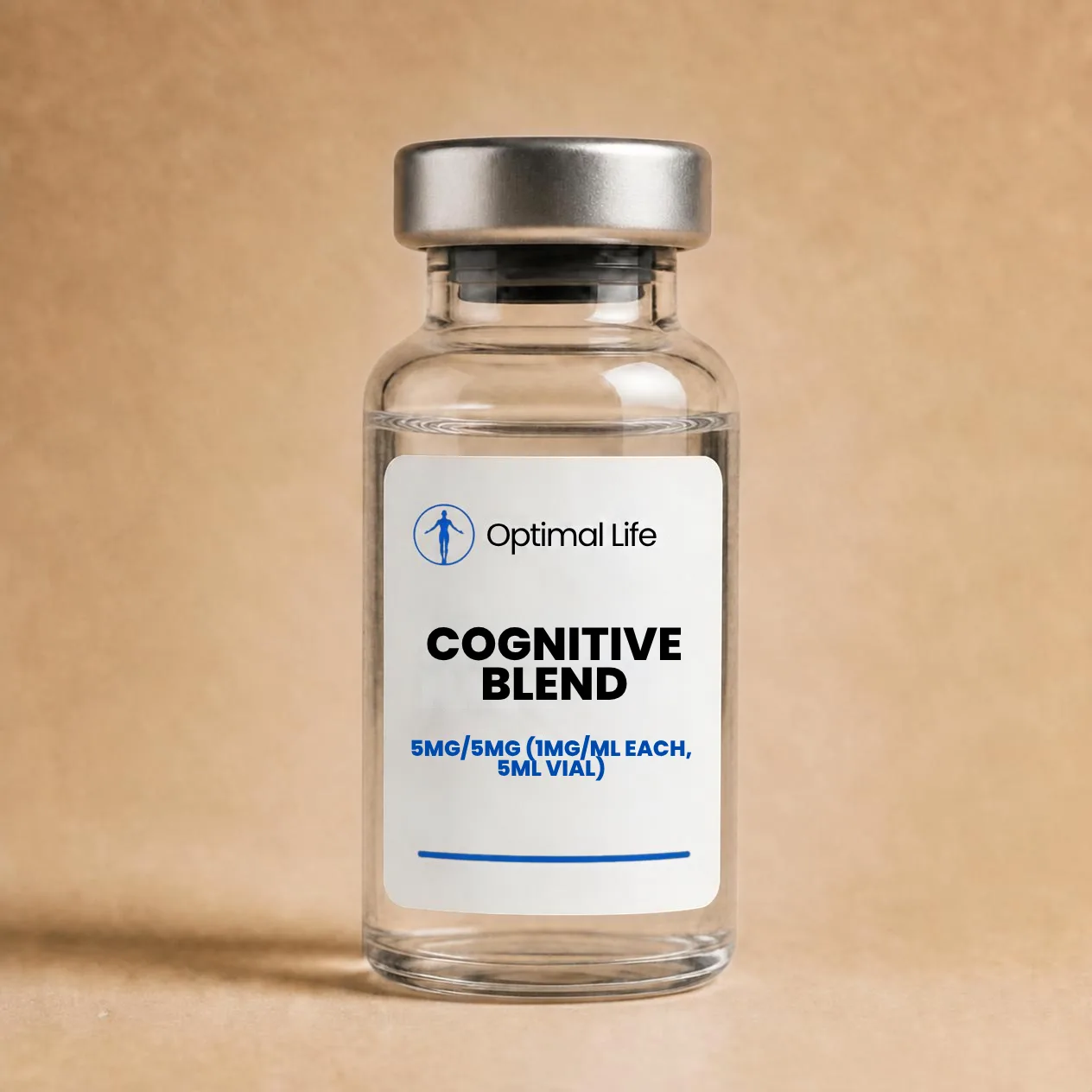
Semax and Selank are synthetic peptides investigated for different neurological and biological effects. Semax has been studied in research involving neurotrophic signaling and neurological function, while Selank has been investigated for anxiety-related pathways and neurotransmission. However, evidence from studies of individual peptides does not establish the safety or effectiveness of combining them. Neither the Semax/Selank combination nor its stated formulation is FDA-approved, and the safety and effectiveness of this specific blend have not been established. The labeled concentration of 1 mg/mL of each peptide in a 5 mL vial corresponds to 5 mg of Semax and 5 mg of Selank, assuming the label specifies those concentrations throughout the vial. These amounts are product specifications, not recommended doses.
Semax and Selank are distinct synthetic peptides that have been studied primarily in Russian research settings. Semax has been investigated for potential effects on neurotrophic signaling and neurological processes, while Selank has been studied for its potential relationship with anxiety-related pathways.
Their proposed mechanisms and available evidence are not interchangeable. Research involving one peptide cannot establish the effects of the other, and findings from individual compounds do not demonstrate that combining them provides additional benefits.
The Semax/Selank combination has not been established as safe or effective in adequate clinical trials. The FDA has not approved this combined formulation as a drug.
What Is Semax?
Semax is a synthetic heptapeptide derived from a fragment of adrenocorticotropic hormone (ACTH). It has been investigated in research involving neurotrophic signaling and neurological function.
Additional Information
| Molecular formula | C₃₄H₅₁N₉O₁₀S |
| Molecular weight | ~813.93 g/mol |
| Amino acid sequence | Met-Glu-His-Phe-Pro-Gly-Pro (MEHFPGP) |
| CAS number | 80714-61-0 |
Research focus
Experimental studies have examined Semax's effects on brain-derived neurotrophic factor (BDNF), a protein involved in neuronal function and synaptic plasticity. A 2006 study in rats reported increased BDNF levels in specific brain regions following Semax administration. Other research has investigated Semax in patients undergoing rehabilitation after ischemic stroke.
These findings should be interpreted within their study contexts. Animal studies do not establish clinical benefits in humans, and studies conducted in specific clinical populations do not demonstrate that Semax improves memory, attention, or neurological health in otherwise healthy individuals.
Safety and regulatory status
Semax is not FDA-approved for any use in the United States. The FDA has identified potential immunogenicity concerns involving aggregation and peptide-related impurities, along with insufficient safety information for proposed routes of administration.
What Is Selank?
Selank is a synthetic heptapeptide related to the endogenous peptide tuftsin. It has been investigated for potential effects on anxiety-related pathways and neurotransmission.
Additional Information
| Molecular formula | C₃₃H₅₇N₁₁O₉ |
| Molecular weight | 751.89 g/mol |
| Amino acid sequence | Thr-Lys-Pro-Arg-Pro-Gly-Pro (heptapeptide) |
| PubChem CID | 11765600 |
Research focus
A 2008 Russian-language clinical study compared Selank with medazepam in 62 patients with generalized anxiety disorder and neurasthenia. The study reported anxiety-related findings, but its relatively small sample, limited setting, and publication context restrict how confidently the results can be generalized.
These findings do not establish that every Selank formulation is safe or effective. Nor do they establish that combining Selank with Semax produces greater benefits than either compound alone.
Safety and regulatory status
Selank is not an FDA-approved drug in the United States. The FDA has identified potential immunogenicity concerns for compounded drugs containing Selank acetate, including risks associated with peptide aggregation and impurities, and has noted gaps in the available safety information.
Semax and Selank: How They Differ?
| Feature | Semax | Selank |
|---|---|---|
| Peptide type | Synthetic heptapeptide derived from an ACTH fragment | Synthetic heptapeptide related to tuftsin |
| Key research areas | Neurotrophic signaling and neurological function | Anxiety-related pathways and neurotransmission |
| Evidence base | Preclinical research and studies in specific clinical populations | Preclinical research and limited clinical studies |
| FDA-approved drug status in the United States | Not FDA-approved | Not FDA-approved |
| Evidence for the combined formulation | Safety and effectiveness have not been established | Safety and effectiveness have not been established |
Both compounds have been studied in relation to neurological experiments, but both compounds' mechanisms of action are different. One compound cannot prove the effects of another compound because the past studies of one do not validate the combination of the two compounds.
Semax / Selank 5 mg / 5 mg: Dose and Dosage Forms
As per the given product specification, the vial contains:
- Semax: 1 mg/mL
- Selank: 1 mg/mL
- Vial volume: 5 mL
- Total content: 5 mg of Semax and 5 mg of Selank
These figures are based on the information given in the supplied specification and will need confirmation from the product label. The concentration and volume in the vial indicate the dosage form and do not imply the dose, regimen, or therapeutic value of the product.
The route of administration of the product will also need verification. A vial volume of 5 mL does not by itself confirm whether the drug is a dosage form for administration via intranasal, parenteral route, or some other route of administration. Requirements are different for each route of administration, and findings for one route cannot be extrapolated to others.
Safety and FDA Regulatory Status
The Semax/Selank combination is not FDA-approved as a drug in the United States. Neither ingredient's research history establishes approval of the combined product.
Important considerations include:
- Limited evidence for the combination: Adequate clinical studies have not established the safety or effectiveness of Semax and Selank used together.
- Semax safety concerns: The FDA has identified potential immunogenicity risks associated with peptide aggregation and impurities, as well as gaps in safety information for proposed routes.
- Selank safety concerns: The FDA has also identified potential immunogenicity concerns and insufficient safety information for compounded Selank acetate.
- Route-specific uncertainty: Safety findings for one route or formulation cannot automatically be applied to another.
- Product quality: The stated concentration does not independently establish ingredient identity, purity, potency, sterility, stability, or suitability for human administration.
The available evidence does not establish this blend as a proven treatment for memory impairment, attention difficulties, anxiety disorders, depression, or neurological disease.